
Escape The Digital Cage
If your screen use has crept too far, it’s time to address it. Escape The Digital Cage is a comprehensive digital de-addiction program that reduces your screen time by addressing every layer of the habit, rather than generic surface-level fixes.
R. Vishwanath

He actually gets it and that is what stood out to me the most. It didn’t feel like generic advice. The program is so thorough! The way he explains things, the way he writes, the way he helps you through it…there’s a robust structure, unlike anything I’ve seen on this topic. Truly commendable
Shweta Jain

I couldn’t sit without fidgeting on my phone. My main issue was that I would anxiously use my phone almost automatically, even if I had something important to do or just wanted to rest. Now I feel like I am finally getting back the ability to just be with myself
Girish Mandekar

I was addicted to Facebook and Shorts, wife to Instagram and my kid used to spend hours playing Clash of Clans type games. I would feel guilty for scolding my child or to act otherwise because I myself was spending hours doing nothing productive. The deaddiction course has been a boon to our entire family and we are finally starting to gain back some control and get back to creating a better equation with technology. Its like when the entire family collectively decides to eat healthier. Something like that has happened for us with phones now.
Janhavi Singh

My screen time was easily 6–8 hours a day. It wasn’t even enjoyable anymore. I would open my phone without thinking right from the moment I woke up and use it here and there till the moment I slept and just feel bad.
I’ve been good friends with Samar for four years now and right from the very first call he helped me so immensely. I could see why I was caught in this loop and the interventions we decided on helped me so much that I was finally able to create some distance between myself and my screens from day one.
Tejas Khot

No faltu gyaan and tightly addresses the subject. The part that spoke the most to me was I realized that just removing something isn’t enough but you have to replace them with better thing
Siddhant Jariwala

I didn’t think anything would work for me because I’d already tried screen blocking apps. This actually worked and made a difference for me.
Ravina Joshi
“I had a habit of using my phone during work and I work for 10-11 hours a day. I noticed so much improvement from the very first day itself with some simple changes. Within a week my phone use became a fraction of what is was during my work hours. This has been a life saver for me. I don’t know what i would have done without this.”
Your phone is the first thing you reach for in the morning and the last thing you stare at before sleep. A single notification or scroll keeps you hooked for hours. It makes you anxious and leaves you feeling tired and lonely.
You know are losing yourself to a feed and trading reality for the shallow hits of dopamine. The profound, messy beauty of human life is being replaced with a hollow substitute.
So shall we retreat into the woods and throw our devices into a lake? We rely on these devices now and complete abstinence would mean withdrawing from life itself.
Behind the screen is a powerful industry that employs the brightest engineers and has billions of data points revealing what shade of red, what notification sound and which reel keeps you scrolling longer.
These work on every single layer of your life and press on every single button in your brain as digital technology embeds itself everywhere.
That’s where most approaches fail. They try to control the surface without addressing these complexities.
This program is built in the opposite direction.
Rather than putting a bandaid on the symptom or asking you to be disciplined, it addresses the underlying mechanics of the habit.
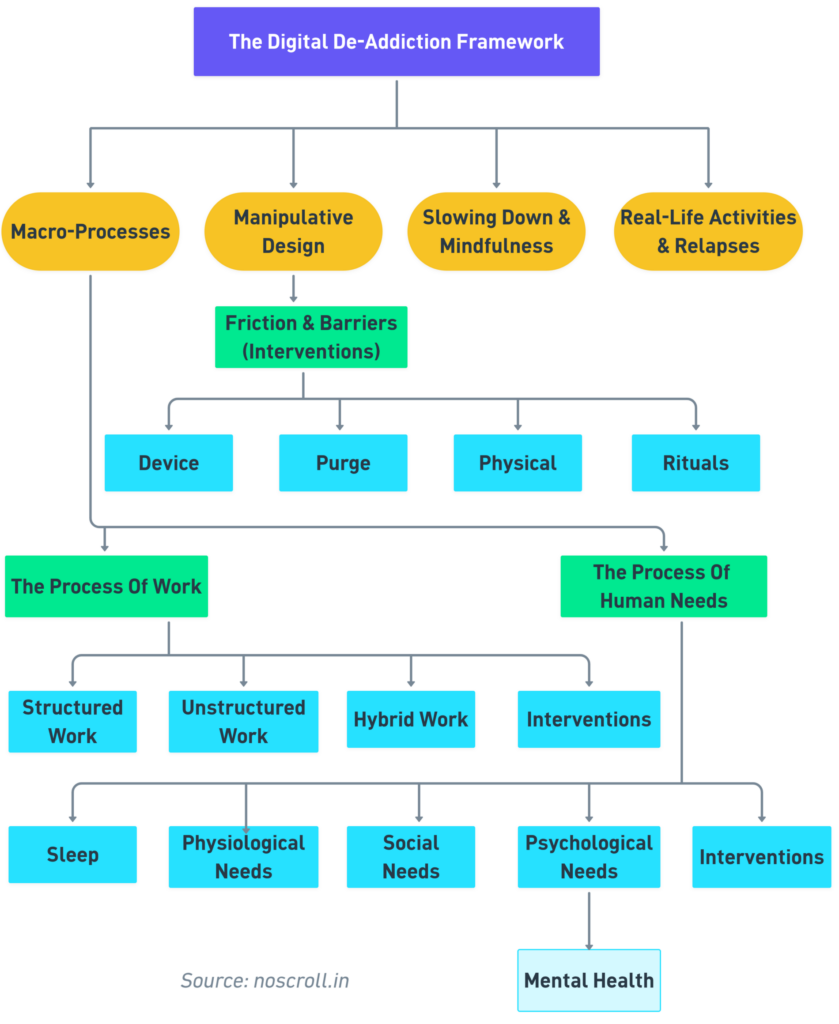
The program is a product of years spent pulling apart digital addiction into its smallest parts, ruthlessly testing what works, discarding what doesn’t, and building a system from the ground up.
It started as an inquiry for my own digital habits and as much as it learns from books and research papers, it comes equally from living the problem and refusing to stop, obsessively, until the problem was remedied.
The program is divided into seven volumes, each containing a long-form video and a written guide that go in depth.
Volume I – The Framework & The End Goal
‘The Framework’ lays out the key layers such as design, modern work, human needs and internal patterns that shape your usage. The volume steps back from tactics to show what you are actually trying to accomplish. It explores how constant distraction erodes the ability to engage deeply with anything meaningful. It looks at what regaining control means in a world built on distraction and what a more intentional relationship with tech looks today.
Volume II – An Entangled Addiction
You learn why stepping away from screens feels so difficult, despite trying repeatedly. It looks at how habit loops, mental triggers, life processes, and the very nature of digital platforms feed one another. It shows how these systems are deliberately designed to exploit human psychology and instead of blaming a lack of will or discipline, it shows how many different biological, psychological, structural and design forces that keep you addicted.
Volume III – Macro-Processes + The Processes Of Work
Macro-processes are the deeper structures of your routine and act like tectonic plates in your life, such that when they shift or shake, everything built on top of them collapses. It examines modern work and how expectations of constant availability, fragmented workflows and digital communication make it difficult to step away from screens. It shows how work overrides various areas of life and causes repeated breakdowns in containing digital use, and the various ways to contain work tremors.
Volume IV – The Processes of Human Needs & Mental Health
The next set of macro-processes collectively labeled as “human needs” comprises family, friendships, movement, nature, sleep, relationships and belonging. When these needs go chronically unmet, they get re-routed as digital consumption, which are convenient but counter-productive substitutes. It also examines conditions such as ADHD, anxiety, depression and autism, and how they intensify patterns of digital overuse, while providing interventions for the same.
Volume V – Design Interventions
This volume examines the malicious design principles used by modern apps and websites to keep you engaged for as long as possible by removing natural stopping cues and using sleazy tactics. It looks at features like infinite scroll, autoplay, notifications, algorithmic feeds, endless recommendations, bright color palettes, variable rewards, background music, et cetera. With around 30 distinct interventions, it provides practical methods to counter these manipulations across smartphones, computers and other screens.
Volume VI – Slowing Down
This volume looks at how the nature of digital platforms, unreasonable demands of modern life, compressed information and rising speeds, keeps the mind in a state of continuous reactivity. It highlights how the deeper anxieties under our skin drive us back to our devices. It offers perspective shifts that help you step out of that momentum and cultivate enough space between stimulus and response to consciously step back from digital technology.
Volume VII – Real-Life Systems
This final volume brings together all the preceding components and interventions with a guided protocol. It looks at the friction involved in replacing digital with wholesome, real-life alternatives and provides a framework to ease the transition. It also discusses relapse as an expected part of the process and a SOS protocol to step out of a spiral. It talks about AI and how it makes matters worse at an exponential pace. It explains why now, more than ever, it is essential to regain control of your digital habits before you get carried away with increasingly powerful technologies driven by AI.
Preview & Pricing
Below are a couple of snippets from the written material from Volume I and Volume __ respectively. You can click the cover image below to view the preview
Across the volumes, the program includes 2 hrs 34 mins of video content and 90,000+ words of written material. The videos follow the same style as those on the website, with the same manner of speaking and setup. They are in English with English subtitles, clear audio, and a no-frills format free from music and loud animations. Upon purchase, the entire program is downloadable as a ZIP file. The written guides are in PDF format, and both the videos and PDFs open on commonly used applications. The complete program is priced at ₹5,499 / ~$60, all inclusive.
The Cost Of Attention
If your screen use is 3 hours/day, that’s 90 hours a month, over 1000 hours a year and 15 years of your waking life. For most people, their screen use is far higher than 3 hours.
Once you add intentional and unconscious use, and the years already lost to movies, texting, TV shows, video games and social media, that’s a life entirely consumed by stimulation.
It’s time that could have gone into projects that move you forward, conversations that deepen connection, books that alter your life, or travel that fills you with childlike joy. If the program saves a part of your precious time, it pays for itself multiple times over.
You know what it feels to hear yourself say “here goes another day” as you scroll and still be unable to stop yourself. To look back at your weeks and months and see them dissolve into the same patterns. You know this is taking too much out of you.
It doesn’t have to be this difficult or painful. You do not have to keep carrying the shame and despair. You don’t have to watch yourself crumble and get pulled further away from the life you actually want.
You should be able to enjoy a sunset or fall asleep without a device accompanying you. These tools were meant to serve us, not the other way around. Reclaim your attention from addictive digital technology and regain your sanity and sanctity, now.
FAQs
Is it about discipline and willpower?
No, not at all. If anything, the program completely de-personalizes your responsibility to exercise your will or discipline. While they do play a role, relying on them alone doesn’t help at all in the long term. Most people who struggle with this have already tried to exert more control, repeatedly. This program looks instead at the structures, environments and psychological patterns that shift the focus from forcing control to understanding and reshaping the conditions that drive the behavior.
Is it only for severe addiction or for moderate usage?
The line between moderate use and addiction is very thin today. If you use your desktop for eight hours, use your phone for four more, listen to music for a couple hours, and then watch a movie all in one single day, no one would bat an eye. If anything, that’s the norm lately. Which begs the question, what is “moderate”? Secondly, given how powerful the technology is today, there’s very little preventing your 30-mins usage turning into a two hour binge. So the only way forward, irrespective of where you fall on the spectrum of usage, is to keep your usage as low as you can. Which in other words means, this program is for everyone.
Are you a therapist or a counselor?
No, I am not a therapist and neither is this program a replacement for therapy. You are urged to seek out a licensed counselor if you need help at the moment or during the course of the program. The program addresses the layer of digital mediation that sits on top of your psychology and is very influential in how you feel. Neither, therapy nor the program is a replacement for the other but are meant to work in conjunction.
What results can I expect realistically?
You will notice immediate reduction in screen time once you implement the interventions from the program. With a clearer understanding of why your usage is the way it is, you can expect increased control over impulses. More importantly, the program will make sure it sustains and that your use of technology feels more intentional rather than reactive.
Do I have to completely quit social media?
No but yes. If you can use social media apps without them feeling compulsive, then you need not quit. However, social platforms are engineered to a level of addictiveness where you get immediately hooked and keep getting pulled back. They are simply too good for you and it is extremely difficult to stop once you start using them, so it’s better to get rid of them. If not, you must have extremely strong boundaries around it, which the program will help you set.
My situation is extremely peculiar or difficult. Will this still apply to me?
When you look beneath the hood, the underlying patterns of how attention is captured and how habits form tend to follow similar structures. This program focuses on those deeper mechanics and remains relevant across a wide range of individual situations. If despite that you feel that your situation is too complex or peculiar to fit the norms, you may require specialized help in the form of one-on-one sessions.
What if my work requires me to be online all the time?
This is increasingly the norm and the program fully considers it. The goal is not to eliminate necessary screen use, especially when it is tied to your work or responsibilities. The program focuses on helping you reduce use that is detrimental and unconscious. It tries to protect you from the spillover or the way work-related usage blends into personal overuse. You don’t have to give up on your work.